How to make more money at a nail salon
Raise dollars per chair-hour. Name a print add-on, price it $25–$45, and stop giving custom art away. Only official O'2Nails distributor for Canada and the USA. V11 $2,999 CAD. X12.5 $5,999 CAD.
Full salon-money guide · Official distributor
How to Make More Money at a Nail Salon · 12 Ways to Increase Nail Salon Revenue · Is a Nail Salon Profitable
How to make more money at a nail salon — average ticket
Here's a question most salon owners can't answer on the spot: what is the single fastest way to lift your average ticket without adding a single minute to the appointment? Not a new chair. Not a second tech. A menu line. Once a printer is on the counter, the print itself takes well under a minute — so the thing that decides whether you make money isn't the hardware, it's how you write the menu around it. That's the part nobody walks you through when you buy the machine.
Why does the menu — not the machine — decide your return?
A nail printer is a fixed cost. Whether you bought the V11 at $2,999 for a single chair or the wall-mounted X12.5 at $5,999 for a multi-chair floor, the purchase price doesn't change based on how you sell. What changes is the menu. Two salons can own the exact same printer; one folds "design" into the base gel price and barely notices a lift, while the other lists three named art tiers and watches the average ticket climb. Same machine, different menu, completely different month.
The mistake is treating printed art as a yes/no add-on. When it's just a single "nail art" add-on line, clients either take it or skip it, and you've capped your own upside. When it's a structured menu — express, signature, custom — clients self-select up, because most people, given three options, do not pick the cheapest one.
How should you structure a printed-nail-art menu?
Build three tiers, not one. Each tier is the same print process; the difference is design complexity, customization, and the story you tell. Here's a structure that works for most salons:
| Tier | What it is | Print time | Best for |
|---|---|---|---|
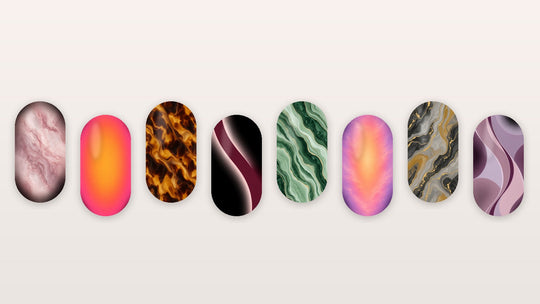
| Express Art | One catalog design across all ten nails, chosen from the library | Seconds per nail | The walk-in who'd normally skip art entirely |
| Signature Art | Mixed designs, accent nails, seasonal sets you put together | Under a minute per set | Your regular who wants something "done for her" |
| Custom Photo | The client's own photo, logo, or artwork printed onto the nail | Under a minute per set | Events, brides, and the client who wants the unrepeatable |
Notice the print time barely moves between tiers — that's the whole point. You are charging for the design and the experience, not the minutes. A custom photo set takes about as long to print as an express set, but it's worth far more to the client, and it's something no sticker or hand-painter down the street can match.
What should each tier cost?
Pricing is local — it depends on your market, your base service price, and your clientele — so treat these as a framework, not a rule. The principle: each step up should feel like a small, obvious yes. If your base gel set is your anchor, an Express Art tier sits as a modest add-on, Signature roughly doubles that add-on, and Custom Photo carries a premium because it's genuinely one-of-one. The gap between tiers matters more than the absolute numbers. Three options priced too close together don't move anyone; clear steps do.
Before you commit prices to a printed menu, model it. Plug your appointment volume and your add-on prices into the ROI calculator and see where your average ticket lands. Results vary by business, pricing, local demand, and execution — the calculator just lets you test the math with your own numbers instead of mine.
How does this change your average ticket?
Think of it as illustration, not a promise. Say a quarter of your clients in a day take an Express Art add-on, a smaller share step up to Signature, and a couple of event clients a week book Custom Photo. None of those prints adds meaningful time to the appointment, so you're not losing chair turns — you're raising the value of turns you were already doing. Stack that across a week and the lift compounds. The reason this works is throughput: hand-painting that same art would cost you 20 to 40 minutes a client, which is why most salons quietly stop offering it. Printing removes the time penalty, so the menu can finally do its job.
If you want to see how printed versus hand-painted art actually pencils out for a salon, we ran the side-by-side numbers in this breakdown.
Which printer fits which menu?
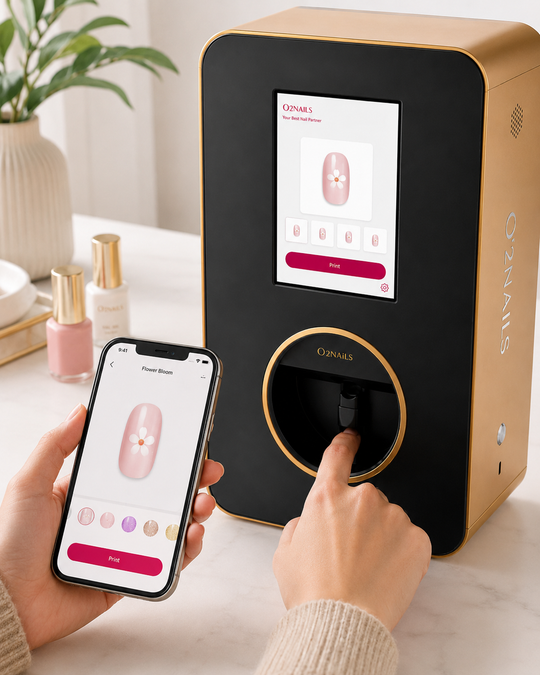
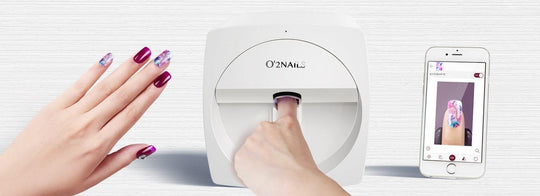
The menu you want to run should drive the machine you buy, not the other way around. If you're a single chair, a mobile tech, or a small studio testing printed art for the first time, the V11 is the easy entry point — app-controlled, pocket-footprint, and enough to run all three tiers. If you're a multi-chair salon where clients will be browsing designs while you prep, the X12.5 mounts on the wall, frees your counter, and produces photo-grade prints in seconds, which makes the Custom Photo tier feel effortless. Both are stocked and shipped by NailPrinter.ca, the only official O'2Nails distributor for Canada and the USA. Not sure which fits? Our Canada and USA buying page lays out the difference.
What about ink cost per service?
This is the number every owner asks about, so let's be transparent about the math rather than wave it away. Ink ships in refill packs of 2, 4 or 6 cartridges, starting at C$673.93 for two. Using a reference yield of about 100 manicure sets per cartridge, that works out to about C$3 of ink per full set — call it about about thirty cents a nail. That 100-sets figure is a planning assumption, not a guarantee, and your real yield depends on design coverage and habits. But even doubled, the ink cost on a printed set is a rounding error against what the tier earns. The economics of the menu are not fragile.
How do you build a bridal and event tier? (wedding season)
It's wedding season, which is the single best time to launch your Custom Photo tier. Bridal parties want matching, personalized sets — a monogram, a wedding date, a photo — and they book in groups, which means one booking can fill multiple chairs with your highest-margin tier. List a "Bridal & Event" package on the menu now, while the demand is in the room. A printed custom set takes under a minute per person, so a party of six doesn't blow up your schedule the way hand-painting six custom sets would.
FAQ
Should printed nail art be a separate menu line or bundled into the base price?
Separate, and tiered. Bundling it into the base price hides the value and caps your upside. Three named tiers let clients self-select up, which is where the average-ticket lift comes from.
How many printed-art tiers should a salon menu have?
Three is the sweet spot: an entry tier, a mid tier, and a premium custom tier. Two doesn't give clients a "middle" to land on; four or more creates decision fatigue.
Does adding printed art slow down appointments?
No — that's the point of printing. The print itself runs in well under a minute, versus the 20 to 40 minutes hand-painted art can take, so you raise ticket value without losing chair turns.
What does the ink actually cost per manicure?
About C$3 of ink per full set, based on a reference yield of about 100 sets per cartridge and refill packs starting at C$673.93 for two cartridges. Treat the 100-sets figure as a planning assumption, not a hard guarantee.
Which O'2Nails printer is best for a multi-chair salon menu?
For multi-chair floors, the X12.5 wall-mount frees counter space and prints photo-grade sets in seconds. A single chair or mobile tech can run the same three-tier menu on the V11.
Next step
Set your tiers, then test the math before you print the menu cards.
Run your numbers in the ROI calculator →
— NailPrinter Team, NailPrinter.ca
New salon-money and vendor guides
Only official O'2Nails distributor for Canada and the USA. Live prices: V11 $2,999 CAD, X12.5 $5,999 CAD, 90-day trial.
- How to make more money at a nail salon
- How to Make More Money at a Nail Salon
- 12 Ways to Increase Nail Salon Revenue
- Nail Salon Owner Salary
- How Much Do Nail Salon Owners Make
- 7 Strategies to Boost Nail Salon Profit Margins
- Is a Nail Salon Profitable
- How to Increase Nail Salon Profits
- 10 Ways to Make More Money as a Nail Tech
- How Much Do Nail Salon Owners Make Per Month
- How to Increase Nail Salon Revenue
- How much do nail salon owners make per month
- 7 strategies to boost nail salon profit margins
- How profitable is a nail salon
- Is a nail salon profitable
- 10 ways to make more money as a nail tech
- How to make more money as a nail tech
- Nail salon upsell scripts
- Official O'2Nails distributor
- What to ask a nail printer vendor
- Where to buy SM10 cartridges
- Salon growth hub